
This topic page is part of a collection of resources related to understanding forest carbon.
Browse the full set of resources
Forests vary in the total amount of carbon they store and how this carbon is distributed across different carbon pools. Forests also vary in their rates of carbon uptake from the atmosphere and in how quickly carbon is transferred from one pool to another. The movement of carbon between pools or between the atmosphere and land is called a carbon flux. Within a forest stand, carbon fluxes and pools are influenced by different forest characteristics including:
- Stand age
- Tree species composition
- Structural diversity
- Soil properties
- Climate
Stand Age
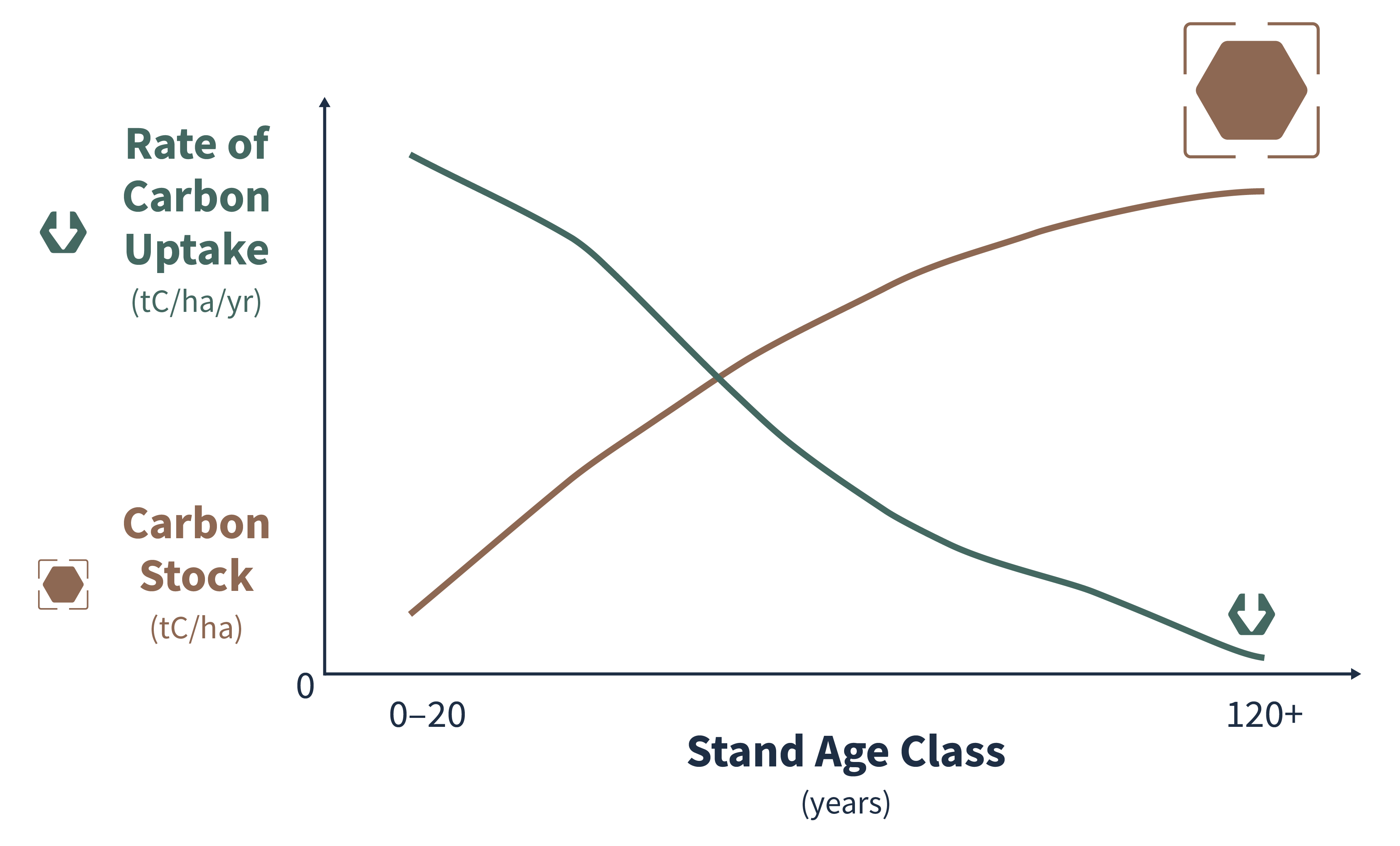
In general, older forests hold more carbon in trees, and younger forests take up carbon more quickly from the atmosphere (Figure 1). Older forest stands usually contain larger trees, which have more biomass (such as the trunk, stem, and leaves), so they store more carbon stock than younger forests with smaller trees. On the other hand, younger forest stands have higher rates of carbon uptake. The rate of carbon uptake steadily decreases with stand age even as the total amount of carbon stored in aboveground live biomass increases with stand age.
Tree Species Composition
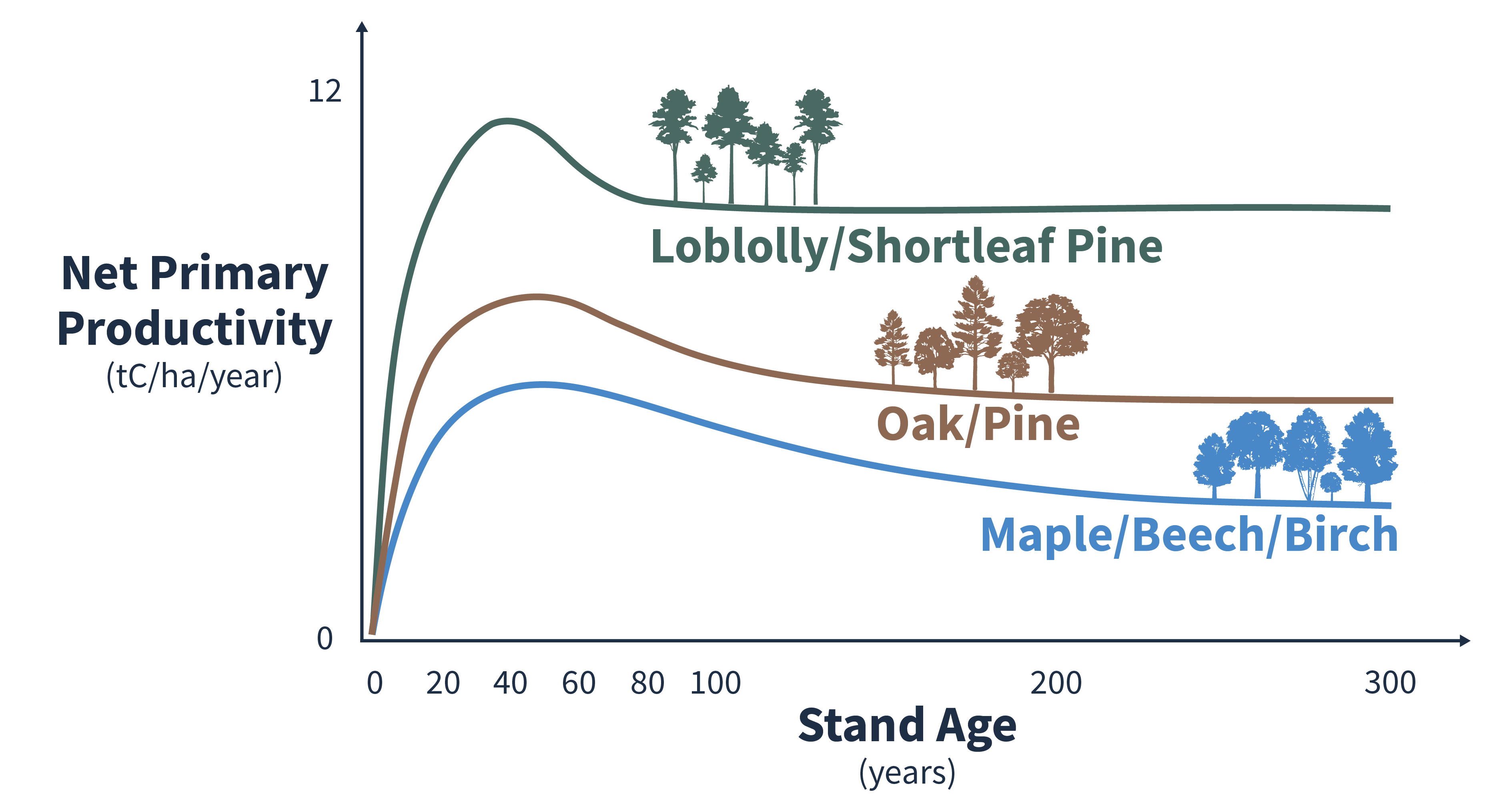
The combination of tree species in a forest stand, or tree species composition, affects how quickly the stand grows and converts carbon from the atmosphere into new biomass, a process known as net primary productivity (NPP). In general, rates of annual biomass accumulation (NPP) increase in the early stages of forest stand development but become stable or even decline as forests age (Figure 2). Tree species composition also influences the age at which the stand experiences peak carbon uptake before rates of carbon uptake start to slow. Though the rate of carbon uptake diminishes with age, a forest will remain a carbon sink if it has a positive NPP rate, even if the rate is decreasing. There are limited data on NPP in old forests, making our estimates of carbon dynamics in old forests less certain (Thom et al. 2019).
Structural Diversity
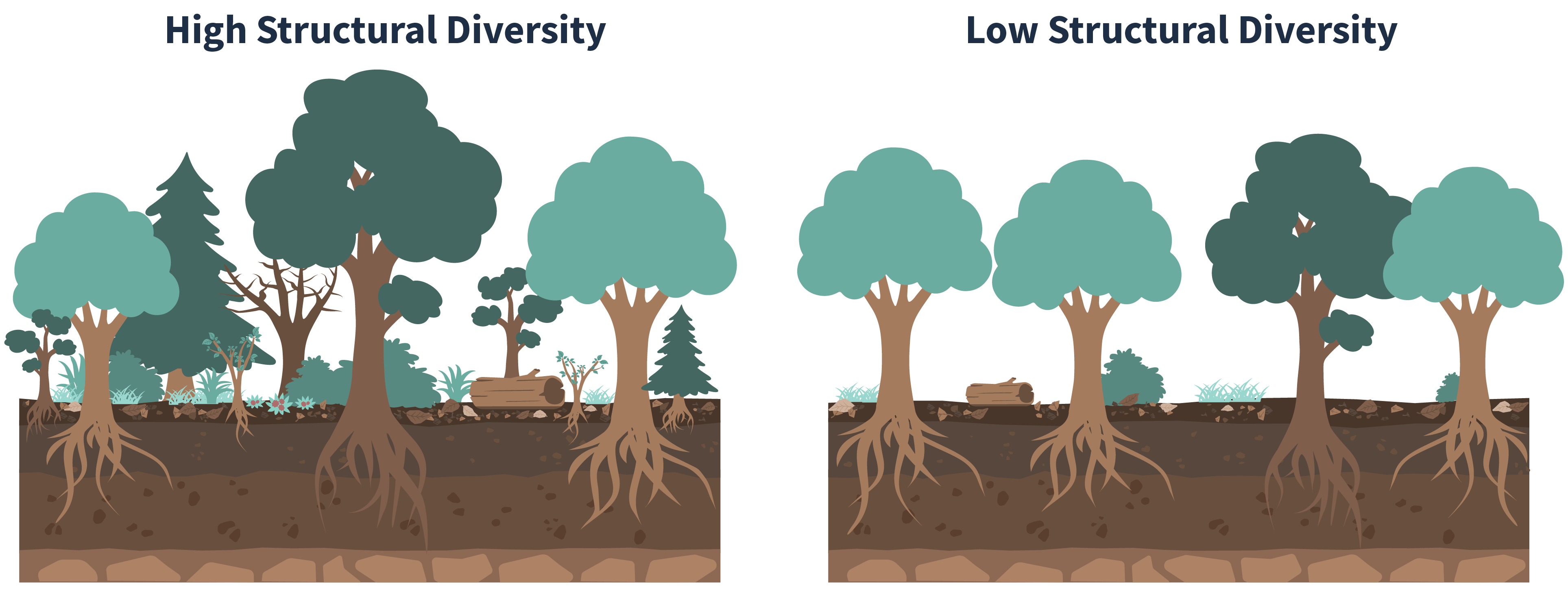
Forest stands with more structural diversity tend to have higher rates of carbon uptake (Figure 3) (Atkins et al. 2018; 2023; Hardiman et al. 2013; Murphy et al. 2022; Scheuermann et al. 2018). Structural diversity can take a variety of forms, including how stems are arranged across space (for example, the patchiness of individual trees across a stand), the height of trees, and the amount of leaf area. A forest with high structural diversity has multiple layers of vegetation spanning the canopy to subcanopy and understory, along with substantial downed woody debris (limbs and similar coarse material on the ground). Such a forest is able to store more carbon vertically in all of its layers than a less structurally diverse, even-aged forest that has little variation in tree height and no subcanopy.
Soil Properties
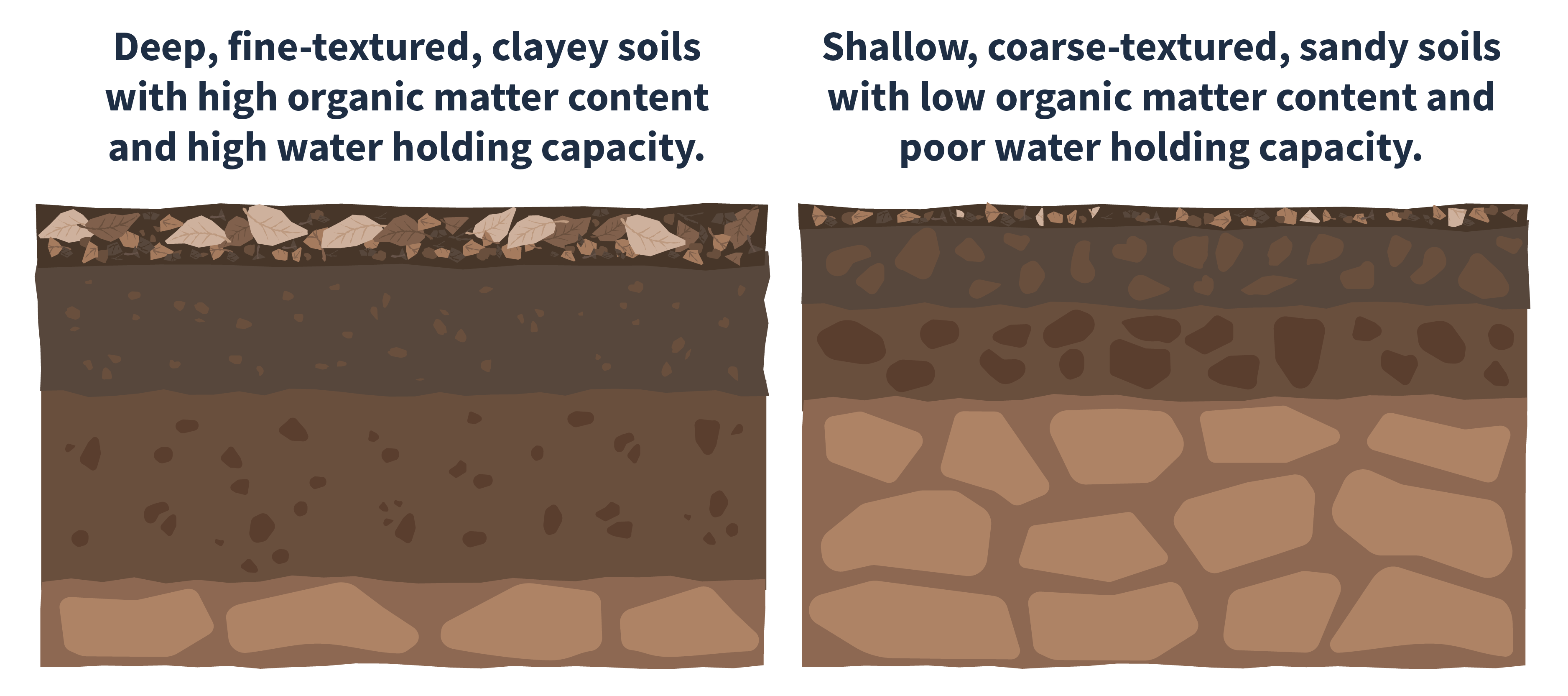
Soil depth, soil type, and other soil properties affect the carbon storage of a forest. Deeper soils typically store more carbon per area than shallow soils, and fine-textured, clayey soils store more carbon than coarse, sandy soils (Figure 4). In addition to having a direct effect on the soil carbon pool, soil properties influence aboveground carbon. Soils that have high organic matter content and high water holding capacity are able to support greater aboveground biomass and live carbon storage compared to soils with low organic matter, poor drainage, or low cation exchange capacity (a general indicator of soil productivity potential) (Nave et al. 2017).
Climate
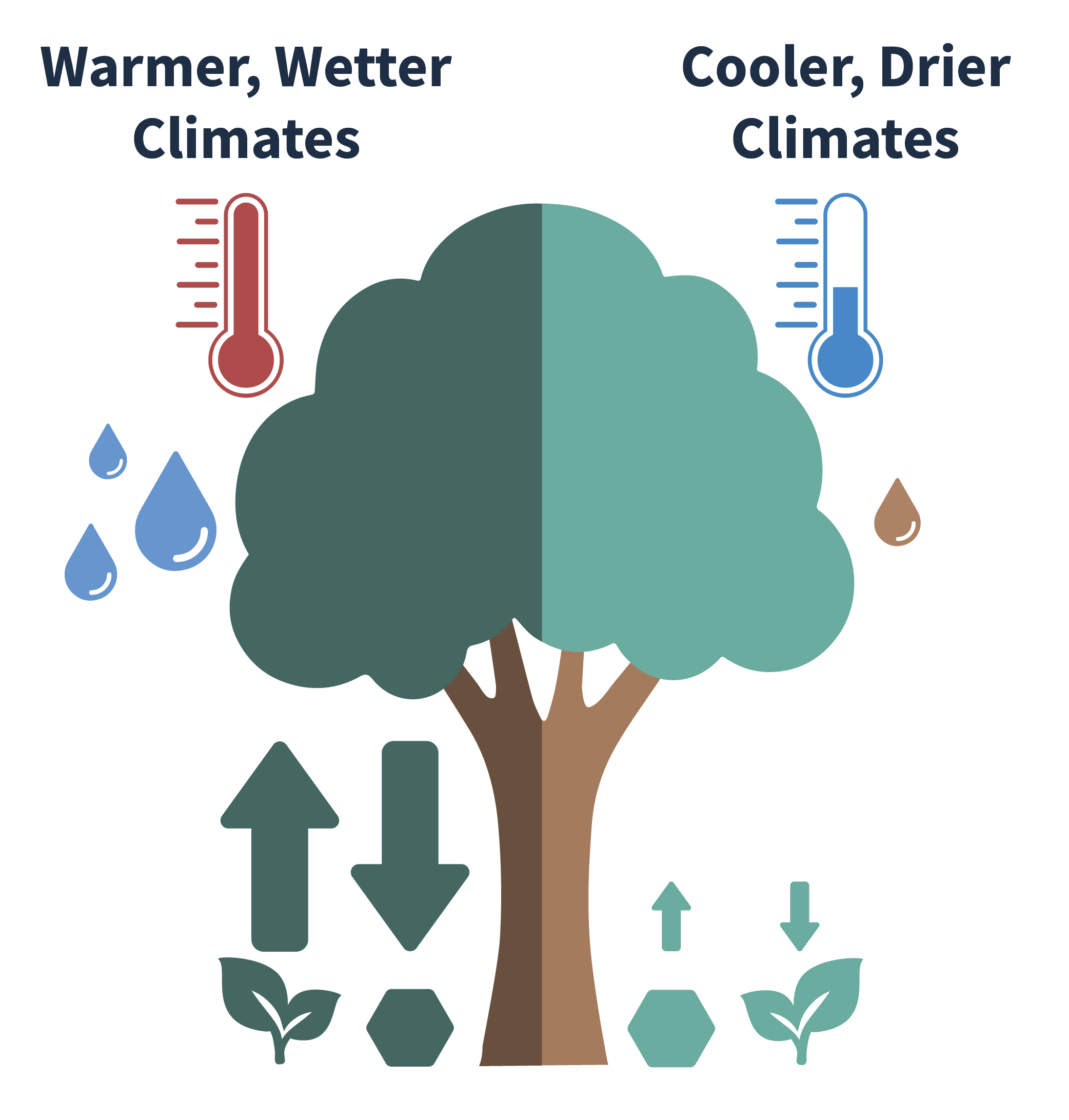
Climate plays a strong role in regulating forest carbon. Warmer and wetter climates support higher rates of vegetative productivity and carbon uptake compared to cooler and drier climates (Figure 5). For example, in a study across the northwestern part of the Great Lakes region, annual biomass accumulation was found to be higher in the southern, warmer part of the region compared to northern Minnesota, where it is drier and colder (Nave et al. 2017).
Key Terms:
- Biomass
- Canopy
- Carbon flux
- Carbon pool
- Carbon sink
- Carbon storage
- Carbon uptake
- Downed woody debris
- Forest stand
- Net primary productivity
- Subcanopy
- Understory
For more terms and definitions, see the Carbon Terminology page.
References
Atkins, J.W.; Fahey, R.T.; Hardiman, B.S. [et al.]. 2018. Forest canopy structural complexity and light absorption relationships at the subcontinental scale. Journal of Geophysical Research – Biogeosciences. 123(4): 1387–1405. https://doi.org/10.1002/2017JG004256.
Atkins, J.W.; Bhatt, P.; Carrasco, L. [et al.]. 2023. Integrating forest structural diversity measurement into ecological research. Ecosphere. 14(9): e4633. https://doi.org/10.1002/ecs2.4633.
Birdsey, R.A.; Dugan, A.J.; Healey, S.P. [et al.]. 2019. Assessment of the influence of disturbance, management activities, and environmental factors on carbon stocks of U.S. national forests. Gen. Tech. Rep. RMRS-GTR-402. Fort Collins, CO: U.S. Department of Agriculture, Forest Service, Rocky Mountain Research Station. 116 p. https://doi.org/10.2737/RMRS-GTR-402.
, C.M.; , A. [et al.]. 2013. Maintaining high rates of carbon storage in old forests: a mechanism linking canopy structure to forest function. Forest Ecology and Management. 298: 111–119. https://doi.org/10.1016/j.foreco.2013.02.031.
Hoover, C.M; Smith, J.E. 2023. Aboveground live tree carbon stock and change in forests of conterminous United States: influence of stand age. Carbon Balance and Management. 18: 7. https://doi.org/10.1186/s13021-023-00227-z.
; , J.A.; , B.J. [et al.] 2022. Unraveling forest complexity: resource use efficiency, disturbance, and the structure-function relationship. Journal of Geophysical Research – Biogeosciences 127: e2021JG006748. https://doi.org/10.1029/2021JG006748.
Nave, L.E.; Gough, C.M.; Perry, C.H. [et al.]. 2017. Physiographic factors underlie rates of biomass production during succession in Great Lakes forest landscapes. Forest Ecology and Management. 397: 157–173. https://doi.org/10.1016/j.foreco.2017.04.040.
, L.E.; , R.T. [et al.]. 2018. Effects of canopy structure and species diversity on primary production in upper Great Lakes forests. Oecologia. 188: 405–415. https://doi.org/10.1007/s00442-018-4236-x.
Thom, D.; Golivets, M.; Edling, L. [et al.]. 2019. The climate sensitivity of carbon, timber, and species richness covaries with forest age in boreal–temperate North America. Global Change Biology. 25: 2446–2458. https://doi.org/10.1111/gcb.14656.
About this Topic Page
This text was prepared by:
- Adrienne Keller, Northern Institute of Applied Climate Science, Michigan Technological University.
- Katie Frerker, Northern Institute of Applied Climate Science, USDA Forest Service Eastern Region.
- Manashree Padiyath, formerly Northern Institute of Applied Climate Science, USDA Forest Service Northern Research Station.
- Kailey Marcinkowski, Northern Institute of Applied Climate Science, Michigan Technological University.
Graphics were adapted, designed, and produced by Kailey Marcinkowski, Northern Institute of Applied Climate Science, Michigan Technological University.
This topic page is part of a collection of resources related to understanding forest carbon.